Bernard House
The oldest building in the Village. Its left half dates to about 1800, the right a later addition, and inside is the finest surviving example of bousillage entre poteaux.
A field trip to Lafayette — and the houses that inspired Le Maison Deslatte
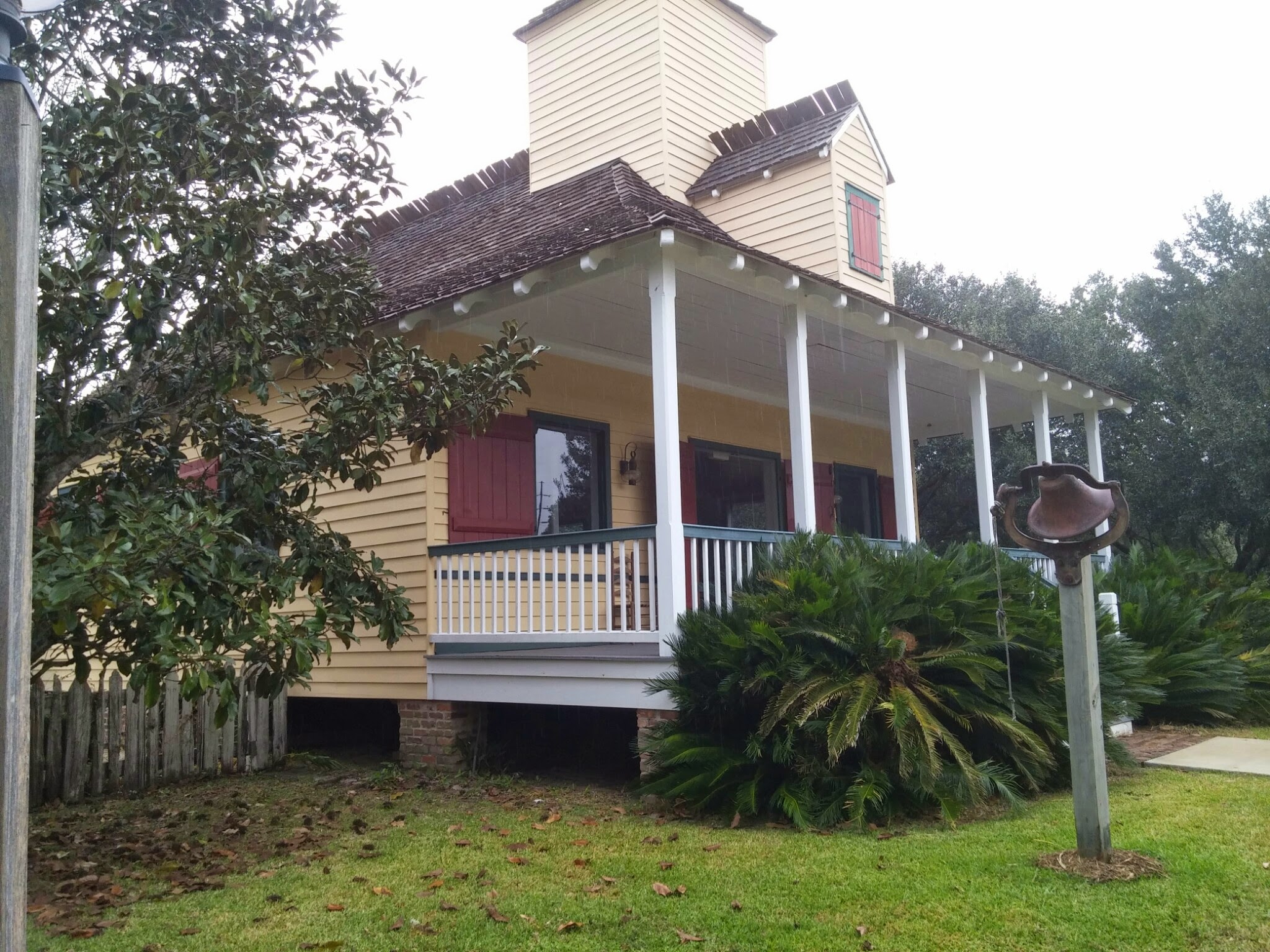
In the autumn of 2014, before they began the remodel of their home on College Drive, Leo and Dianne Deslatte made a field trip to Lafayette, Louisiana. They spent the day at LARC’s Acadian Village, walking through authentic Cajun houses of the 1800s — and photographing every porch rail, rafter, and door latch they could find.
They came to gather ideas for the authentic Acadian home they hoped to make of their own house. These are the buildings they toured that day, and what those old houses can still teach about the way the Acadians built.
LARC’s Acadian Village sits on a wooded, thirty-two-acre tract in Lafayette. It belongs to LARC, an organization that serves people with intellectual and developmental disabilities — and every admission, wedding, and event held at the Village still helps support that work.
The Village was conceived in the early 1970s by Dr. Norman Heard, Bob Lowe, and Glen Conrad, who set out to recreate a typical 1800s Cajun community. Ten acres of farmland were reshaped into a shaded settlement with a bayou dredged through its center, and historic houses were brought in, moved piece by piece and carefully restored. Local carpenters, businessmen, civic clubs, and even Army Reservists pitched in to build it. Of the eleven structures gathered there, seven are genuine nineteenth-century homes, donated by the families whose ancestors once lived in them.
The houses the Deslattes toured were not grand. They were the homes of farming families — small, practical, and beautifully made, shaped as much by the Louisiana climate as by the carpenter’s hand. A handful of features repeat from house to house, and together they describe a way of building.
Almost everything was cypress. Cut from the surrounding swamps, cypress resists rot and insects so well that it earned the name bois éternel — the wood eternal. Timbers were hand-hewn square, then joined with wooden pegs rather than nails, which were scarce and dear. At the Thibodeaux House, every pre-cut beam and post still carries a Roman numeral, scratched in so the frame could be raised like a puzzle, each piece in its place.
Between the cypress posts of the walls, the builders packed bousillage — a stiff mixture of clay mud and Spanish moss, worked by hand into every gap. The method, called bousillage entre poteaux, “mud between posts,” insulated the house against both heat and cold. The Bernard House, the Village’s oldest building at around 1800, holds its finest surviving example.
Few of these houses sit on the ground. They stand on piers — first squared cypress blocks, later brick pillars — lifting the floor a foot or two into the air. The gap let floodwater pass beneath, kept damp and termites away from the sills, and let cool air move under the house through the long Louisiana summer.
The deep front porch — la galerie — is the heart of the Acadian house. Sheltered by the long overhang of the roof and carried on slender posts, it served as an outdoor room: a place to shell peas, mend nets, watch the weather, sleep on hot nights, and visit with neighbors. The front rooms opened straight onto it, often through two front doors, with no hallway inside.
Look for the staircase climbing the porch wall to a small door under the eaves. It leads to the garçonnière, the loft where the unmarried boys of the family slept. Putting their stair outside, on the gallery, kept the young men’s comings and goings separate from the rooms below — a small, clever piece of social architecture.
The roofs are steep and high-peaked — quick to shed rain, and holding a sleeping loft beneath. Under the gallery, the ceiling is simply the exposed rafters and roof boards. On many houses those boards are painted, a soft red or a blue-green, and the brushwork still shows after a century.
Down to the smallest detail, these houses were made by hand. Porch railings carry rows of plain, sturdy balusters; plank doors hang on hand-forged hinges; latches and pulls were bent and hammered at the forge. The blacksmith was among the most important people in any Cajun community — the maker of every nail, hinge, and tool the village depended on.
Around the houses, the Village keeps the tools of daily life — among them the pirogue, the narrow, flat-bottomed boat, often hollowed from a single cypress log, that carried Cajun families through the bayous and swamps to hunt, fish, trap, and travel.
Seven of the Village’s buildings are true homes of the nineteenth century. Each was lived in, then given by its family, dismantled, and rebuilt beside the bayou.
The oldest building in the Village. Its left half dates to about 1800, the right a later addition, and inside is the finest surviving example of bousillage entre poteaux.
Built of cypress, the “wood eternal.” Every beam and post is marked with Roman numerals, and the boys’ loft is reached by an outside staircase.
Raised from salvaged cypress timbers and named for the street it came from. Today it stands furnished as a one-room schoolhouse.
Built over more than a year by a European craftsman. Its carved cypress mantels survived the house being pillaged during the Civil War.
Brought from the Billeaud Sugar Plantation and kept as the Village’s spinning and weaving cottage, where a 150-year-old loom still stands.
Birthplace of the colorful Cajun state senator Dudley “Couzan Dud” LeBlanc, a lifelong champion of Acadian culture.
A cypress building with Greek Revival touches. Its original cypress shingles still lie beneath the tin roof, over a collection of early medical instruments.
Leo and Dianne came back from Lafayette with a camera full of pictures and a clear idea of what they wanted. The deep galerie, the exposed-rafter porch ceiling, the steep roof, the house lifted off the ground, the honest handmade details — all of it found its way into the remodel of their own home. What began as a modest cottage on College Drive became, in their hands, an authentic Acadian maison.
See how those ideas took shape: read the story of Le Maison Deslatte, and walk through the 2010 framing of the porch and upstairs.
More of the photographs Leo and Dianne took that day. Click any picture to see it larger.
“The old ways are worth keeping alive, worth handing down, worth remembering.”